For years, SEO had a fairly simple goal:
Get your page indexed, rank as high as possible, and earn the click.
That basic idea still matters in 2026.
But search itself is changing.
Google now answers more complex questions directly through AI Overviews and AI Mode, while tools such as ChatGPT can search the web, summarize information and link users to outside websites.
That has created a new set of terms:
AEO. GEO. AI SEO. AI Search Optimization.
And, as usual, the marketing industry has made the whole thing sound more complicated than it needs to be.
The important question is not whether SEO is dead.
It is:
How should you create content when people may discover your website through both traditional search results and AI-generated answers?
The answer is a lot more practical than many people expect.
Google’s own guidance says that its existing SEO best practices still apply to generative AI features in Search. You do not need a completely separate technical strategy just to appear in AI Overviews or AI Mode.
So let’s break down what AEO actually means, where it differs from SEO, and what website owners should focus on in 2026.
What Is SEO?
SEO stands for Search Engine Optimization.
At a basic level, SEO is the process of making your website easier for search engines to understand, crawl and rank.
That includes things like:
- Helpful content
- Search intent
- Keyword research
- Internal links
- Page titles
- Meta descriptions
- Site speed
- Mobile usability
- Structured data
- Backlinks
- Crawlability and indexing
Traditional SEO is mostly about helping a page earn visibility in search results.
For example, someone may search:
best email marketing software for small business
A traditional SEO strategy would try to create a page that deserves to rank for that query.
That is still important.
Google has explicitly said that its generative AI search experiences are built on its existing ranking and quality systems, which is why SEO remains relevant even as the interface changes.
What Is AEO?
AEO usually stands for Answer Engine Optimization.
Instead of thinking only about whether a page ranks as a blue link, AEO focuses on whether information from the page can be easily understood and used when an AI-powered search experience answers a question.
Imagine someone searches:
What is the difference between SEO and AEO?
A traditional search result may show ten websites.
An AI-powered search experience may instead provide a short explanation and cite several sources underneath or inside the answer.
AEO is essentially about making your content useful enough, clear enough and trustworthy enough to become one of those sources.
That sounds very different from SEO.
In practice, though, there is a lot of overlap.
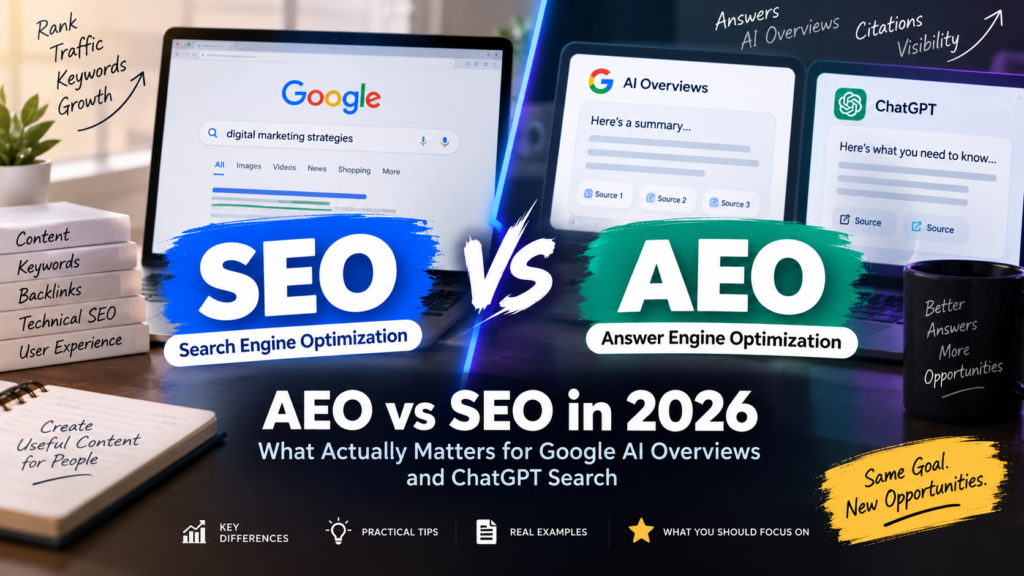
AEO vs SEO: The Real Difference
The easiest way to think about it is this:
SEO tries to make your page discoverable.
AEO tries to make your information easy to understand, extract and reference.
But you usually need both.
A page that cannot be crawled or indexed properly is unlikely to benefit much from AI search visibility.
And a page that ranks but gives vague, generic answers may be less useful when an AI system is looking for a strong source.
So this is not really:
SEO or AEO
It is closer to:
SEO + better content structure + stronger source quality.
That is an important distinction because many website owners are being sold “AI optimization” as if it requires completely rebuilding their sites.
Google says otherwise.
Its 2026 guidance specifically emphasizes that normal SEO best practices remain effective for AI Overviews and AI Mode.
Why AEO Is Getting So Much Attention in 2026
User behavior is changing quickly.
Google says AI Overviews now reaches more than 2.5 billion monthly active users, while AI Mode has surpassed 1 billion monthly users.
In the United States, Google says people are also asking longer, more complex and more conversational questions through AI-powered Search.
Instead of searching:
best laptop 2026
someone may ask:
What laptop should I buy for video editing under $1,500 if I also need good battery life for travel?
That is a very different kind of query.
It contains budget, use case, portability and performance requirements all in one question.
This is where detailed, well-organized content becomes more valuable.
Does Google Have a Separate AEO Ranking System?
Not in the way people sometimes describe it.
Google says AI features in Search rely on its core ranking and quality systems.
That means there is no magic “AEO tag” you add to WordPress that suddenly gets your content cited in AI Overviews.
There is also no special schema called “AEO schema.”
Google’s official guidance focuses on familiar fundamentals:
Make your pages crawlable.
Create useful content.
Use descriptive text.
Provide original value.
Use high-quality images and videos when helpful.
Keep structured data accurate.
Follow Google Search Essentials.
So if someone tells you that traditional SEO no longer matters because “AI SEO has replaced it,” that is an oversimplification.
What About GEO?
GEO usually stands for Generative Engine Optimization.
It is often used to describe optimization for systems such as Google AI Overviews, AI Mode, ChatGPT Search and other generative search tools.
The term is useful as a way to describe a change in user behavior.
But from a practical content perspective, GEO and AEO often lead back to the same fundamentals:
Clear answers.
Original information.
Good technical SEO.
Reliable sourcing.
Strong site structure.
And content that actually adds something useful to the web.
Google even added guidance in 2026 specifically addressing misconceptions around AEO and GEO, while reiterating that established SEO practices still matter.
How Google AI Overviews Choose Information
Google does not publish a simple formula for getting cited in an AI Overview.
And appearing is never guaranteed.
But Google has been very clear about what website owners should focus on.
The page should be accessible to Google.
The content should be useful.
The site should follow Search policies.
And the page should provide something worth showing.
Google has also been making AI Search more link-friendly.
In 2026, it expanded direct links, article suggestions and original-content discovery inside AI Overviews and AI Mode.
That matters for publishers.
AI search is not simply about giving users an answer and ending the journey.
Google is actively building ways to help users continue exploring useful websites.
How ChatGPT Search Finds Websites
ChatGPT Search works differently from Google, but website owners still need to think about crawlability.
OpenAI says public websites can appear in ChatGPT search results.
For your content to be discoverable and clearly cited, you should make sure your site does not block OAI-SearchBot.
That does not guarantee inclusion.
OpenAI says search results are ranked using several signals designed to surface relevant and reliable information.
For a normal website owner, the practical takeaway is simple:
Do not accidentally block legitimate search crawlers if you want AI search traffic.
Can ChatGPT Send Traffic to Your Website?
Yes.
ChatGPT Search can include citations and links to external websites.
OpenAI also adds utm_source=chatgpt.com to referral URLs, which makes inbound ChatGPT traffic easier for publishers to identify in analytics.
So AI search traffic is something worth watching in Google Analytics.
You may eventually start seeing ChatGPT as a referral source even if your traditional Google rankings have not changed dramatically.
What Kind of Content Works Better for AI Search?
The biggest mistake is writing content specifically for a machine.
Write for the reader first.
But make the answer easy to understand.
Consider these two introductions.
Version 1
“SEO and AEO are becoming increasingly important pillars of the continuously evolving digital ecosystem, where businesses must strategically implement modern optimization frameworks.”
Technically correct.
Not particularly helpful.
Version 2
“SEO helps your page get discovered in search. AEO makes the answer on that page easier for AI-powered search tools to understand and reference.”
The second version gets to the point.
That is better for readers.
And it is also easier for a search system to understand.
Answer the Main Question Early
Do not make users scroll through 600 words before you answer the question they searched for.
If your heading is:
Does AI Max replace Search campaigns?
Answer it immediately:
No. AI Max is an optimization layer inside eligible Search campaigns, not a separate replacement for Google Search campaigns.
Then explain the details.
That structure works well because users get the answer quickly while readers who need more information can keep reading.
Use Specific Examples
Generic information is becoming easier for AI systems to summarize.
Original examples are harder to replace.
Suppose you are writing about Meta Ads lead quality.
Instead of saying:
Improve your targeting to get better leads.
Explain something practical:
A local roofing company paying $18 per lead may appear to be performing better than another campaign paying $31 per lead.
But if the $31 leads actually book estimates while the $18 leads never answer the phone, the cheaper CPL campaign may be worse.
That example adds judgment and context.
Google has increasingly emphasized original content, creator insights and firsthand perspectives in its search experiences.
Original Value Matters More Than Rewriting What Everyone Else Says
Imagine 100 websites publish:
10 Best AI Marketing Tools
Every article names the same tools.
Every article gives the same descriptions.
Every article has roughly the same headings.
Why should Google or an AI answer engine choose yours?
A stronger article might add:
- Which tool is best for which business
- Actual limitations
- Pricing differences
- Setup screenshots
- A workflow
- A comparison table
- Common mistakes
- Who should skip the tool
The goal is not to make content longer.
The goal is to make it harder to replace.
Add Sources Where They Actually Matter
Not every sentence needs a citation.
But current facts should have reliable sources.
For example:
A Google Ads rollout date should link to Google.
An iOS feature claim should link to Apple.
A cybersecurity advisory should link to the relevant security authority.
A regulation should point to the government source.
That makes the article more useful for readers and reduces the risk of repeating inaccurate information.
Your opinion or explanation does not need an external citation every two lines.
Use sources where verification adds value.
Structure Content Around Real Questions
Instead of forcing one exact keyword 20 times, build the article around the questions people actually ask.
For example, an article about AEO could naturally include:
What is AEO?
AEO vs SEO: What is the difference?
Does AEO replace SEO?
How do I appear in Google AI Overviews?
Can my website appear in ChatGPT Search?
Do I need special AI schema?
This gives the article natural topical coverage without keyword stuffing.
Are FAQs Still Useful?
Yes—for readers.
But there is an important 2026 update.
Google discontinued the FAQ rich result feature for normal Search in May 2026.
So do not add an FAQ section because you expect a special Google FAQ box.
Add FAQs because they answer useful follow-up questions.
That is still valuable.
Do You Need an llms.txt File?
This has become another popular AI SEO topic.
For Google Search specifically, the answer is no.
Google clarified in June 2026 that llms.txt is not required for Google Search and does not positively or negatively affect visibility or ranking there.
Other platforms may use different systems.
For ChatGPT Search, OpenAI currently tells publishers to focus on allowing OAI-SearchBot rather than relying on llms.txt.
So do not waste time adding technical files just because someone calls them an AI ranking hack.
Schema Still Matters — But Don’t Overthink It
Structured data can help search engines better understand your page.
Google continues to support structured data for things such as articles, products, organizations and other eligible content types.
For a normal blog post:
Use BlogPosting or the appropriate Article schema.
Make sure:
Author is correct.
Date published is correct.
Date modified is correct.
Featured image is relevant.
Headline matches the article.
Do not add fake reviews, fake ratings or unrelated schema just to chase rich results.
What US Websites Should Focus on in 2026
For the US market, I would focus less on producing huge volumes of generic content and more on content with strong intent.
Examples:
Local business:
“Google Ads for HVAC Companies: How to Stop Paying for Irrelevant Leads”
SaaS:
“HubSpot vs GoHighLevel for a 5-Person Sales Team”
E-commerce:
“Google Shopping Ads vs Meta Ads for a New DTC Brand”
SEO:
“How to Update Old Content for Google AI Overviews”
AI:
“Best AI Tools for Local Service Businesses — What Each One Actually Saves Time On”
These topics connect information with a real decision.
That is much more valuable than publishing another generic “What is SEO?” article.
A Practical AEO + SEO Workflow
You do not need a separate department for AI search optimization.
Use a simple process.
First, identify the actual search intent.
Second, answer the main question clearly.
Third, add useful depth.
Fourth, include examples or original observations.
Fifth, verify changing facts with primary sources.
Sixth, use descriptive headings.
Seventh, add relevant internal links.
Eighth, make sure Google and other desired search crawlers can access the page.
Ninth, update the article when the information changes.
And finally, track where traffic actually comes from.
That workflow helps traditional search and AI-powered discovery at the same time.
What You Should Not Do
Avoid these shortcuts:
Do not stuff keywords.
Repeating “AEO vs SEO” in every paragraph will not make the article better.
Do not publish hundreds of nearly identical AI-generated pages.
Quantity without useful value creates a weak site.
Do not invent statistics.
If you cannot verify a number, leave it out.
Do not add fake personal experience.
Do not say “I tested this for 30 days” unless you actually did.
Do not copy competitors.
Research the topic, then write something genuinely useful.
Do not chase every new SEO acronym.
A new name does not always mean a new ranking system.
SEO Is Becoming Broader, Not Irrelevant
The rise of AI search does not make SEO useless.
It changes what good SEO looks like.
A technically optimized page with shallow information is not enough.
A brilliant article that search engines cannot access is also not enough.
You need both.
Think of modern SEO as:
Technical accessibility + useful content + trust + original value + clear answers.
AEO fits inside that larger picture.
Final Thoughts
The debate around AEO vs SEO makes the change in search sound more dramatic than it really is.
Yes, users are increasingly getting answers through AI Overviews, AI Mode and conversational tools such as ChatGPT.
And yes, website owners should think about how their information is understood and cited.
But the core strategy is still recognizable.
Publish useful content.
Make it accessible.
Answer real questions.
Use reliable sources.
Add something original.
Keep the site technically healthy.
Google says its existing SEO best practices continue to matter for AI-powered Search, and OpenAI similarly emphasizes crawl access and relevant, reliable information for ChatGPT Search.
So do not abandon SEO for AEO.
Build content that works for both.
That is probably the safer strategy for 2026—and for whatever search looks like next.
Frequently Asked Questions
What is the difference between AEO and SEO?
SEO focuses on helping pages gain visibility in search engines. AEO focuses more specifically on making answers easy for AI-powered search systems and answer engines to understand and reference. In practice, the two strategies overlap heavily.
Is AEO replacing SEO?
No. Google says traditional SEO best practices still apply to its generative AI search features.
How do I rank in Google AI Overviews?
There is no guaranteed AI Overview ranking method. Focus on Google Search fundamentals: crawlable pages, useful original content, clear structure, accurate information and compliance with Search policies.
Can my website appear in ChatGPT Search?
Yes. OpenAI says public websites can appear in ChatGPT Search. To remain eligible for content discovery and citation, make sure OAI-SearchBot is not blocked.
Do I need llms.txt for Google AI Overviews?
No. Google says llms.txt is not required and does not improve or hurt Google Search visibility.
Should I still use keywords in 2026?
Yes, but use them naturally. Keywords still help identify search intent and topic relevance. They should guide the content rather than be repeatedly inserted just for SEO scores.
Is FAQ schema still useful?
Google stopped showing FAQ rich results in normal Search in May 2026, but FAQ sections can still be useful for readers when they answer genuine follow-up questions.
Disclaimer
This article is for educational and informational purposes only. Search engines and AI platforms frequently change their ranking systems, crawler behavior and product features. Always verify technical requirements through official Google Search Central and OpenAI documentation before making major site changes.
Official Sources
Google Search Central — Generative AI Optimization Guide
Google’s official guidance for AI Overviews, AI Mode and modern SEO.
Google Search Central — 2026 Search Documentation Updates
Includes Google’s clarification on AEO/GEO, llms.txt, FAQ rich results and AI Search guidance.
Google — New Controls and Insights for Website Owners
Current data and publisher guidance for AI-powered Google Search.
OpenAI — Publishers and Developers FAQ
Official guidance on website discovery, OAI-SearchBot and ChatGPT Search referrals.
Last Updated: September 20, 2026