Google Search Ads are changing again.
If you manage Search campaigns, you may already have noticed AI Max appearing inside campaign settings. And in September 2026, this feature became much harder to ignore because Google started moving some existing Search campaign settings into AI Max automatically.
That does not mean every Search campaign is suddenly becoming a completely different campaign type.
AI Max is still a layer inside a normal Search campaign.
The difference is that Google can use more signals to find relevant searches, create additional ad text and sometimes send users to a different page on your website if its system believes that page is more useful for the search.
For advertisers, that can create more opportunities.
But it also means understanding the controls before simply turning everything on.
Google itself describes AI Max as an optimization layer for existing Search campaigns rather than a separate campaign type.
What Is Google Ads AI Max?
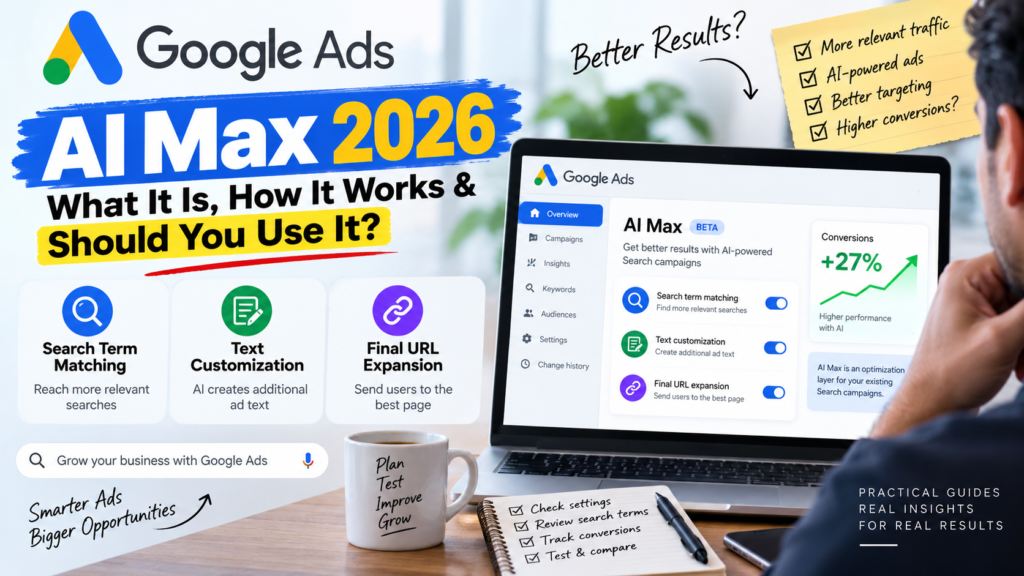
Google Ads AI Max is a group of AI-powered features built into Search campaigns.
Instead of relying only on the keywords, ads and landing page you manually select, AI Max can use additional information from your campaign and website to decide:
Which searches may be relevant, what ad message could fit the search, and which landing page may be the best match.
The three main parts are:
- Search term matching
- Text customization
- Final URL Expansion
You can think of AI Max as Google giving the Search campaign more flexibility while still keeping it inside the Search Ads environment.
Google introduced AI Max for Search campaigns in 2025 and has continued expanding its features and controls through 2026.
1. Search Term Matching
This is probably the most important part to understand.
Normally, advertisers build Search campaigns around keywords.
For example, imagine a real-estate business is using:
3 BHK flats in Gurgaon
With traditional keyword targeting, Google mainly tries to connect relevant searches with the keywords in your campaign, depending on the match type.
With AI Max search term matching, Google can use a wider understanding of intent.
So a person may search something like:
ready to move family apartment near golf course road
Even if that exact phrase is not present in your keyword list, AI Max may still understand that the search is relevant to your business.
Google says search term matching uses broad-match technology along with information from your ads and landing pages to expand reach.
This can be useful because people do not always search using the exact keywords advertisers expect.
But wider reach does not automatically mean better traffic.
You still need to monitor the Search Terms report.
That becomes even more important when Google has more freedom to decide which searches are relevant.
2. Text Customization
Text customization was previously known as Automatically Created Assets.
This feature allows Google to generate additional headlines and descriptions using information already available in your campaign.
That can include:
- Your existing ad copy
- Landing page content
- Domain
- Keywords
- Other campaign assets
Google may then use those generated assets when it believes they are more relevant to a user’s search.
Here’s a simple example.
Suppose your website has a service page for:
WordPress Website Development for Small Businesses
But your Search ad only says:
Professional Website Development
If someone searches:
WordPress website developer for small business
Google may create additional text using relevant information from the landing page.
That sounds useful, but advertisers should still review what Google is generating.
Brand names, pricing, legal wording, location claims and special offers should not be left completely unchecked.
Google provides asset reporting where advertisers can see customized assets that were added by Google AI.
3. Final URL Expansion
Final URL Expansion is one of the features I would pay the most attention to.
Normally, you select the landing page for your ad.
For example:
example.com/google-ads-services
With Final URL Expansion enabled, Google may decide that another page on your website is a better match for a particular search.
Imagine you also have:
example.com/facebook-ads-services
and
example.com/seo-services
If a search is much closer to one of those pages, Google may send the visitor there instead.
The idea is straightforward: send the user to the page that best matches their intent.
Google says Final URL Expansion uses query-relevant pages that fit the theme of the ad group. It also requires text customization because Google may need to adjust the ad copy to match the selected landing page.
This can work well when a website has clear, well-written landing pages.
But if your website has old pages, weak service pages, irrelevant blog posts or URLs you would never want to use for advertising, you should review your URL controls carefully.
What Changed in September 2026?
This is where many advertisers need to pay attention.
Google confirmed that starting in September 2026, Search campaigns using certain legacy settings would begin moving into AI Max.
This includes campaigns using:
Automatically Created Assets / text customization and the campaign-level broad match setting.
For campaigns using automatically created assets, Google says the upgraded AI Max setup can have search term matching and text customization enabled.
For campaigns using the campaign-level broad match setting, search term matching can be enabled as part of the upgrade.
So if you manage older Search campaigns, do not assume nothing has changed just because you never manually enabled AI Max.
Open the campaign settings and check.
What About Dynamic Search Ads?
There was some confusion around Dynamic Search Ads because Google’s timeline changed.
Google originally planned a broader transition from Dynamic Search Ads to AI Max beginning in September 2026.
But after advertiser feedback, Google extended the DSA transition timeline.
The current official update says the Dynamic Search Ads sunset and auto-upgrade will begin in February 2027, while Automatically Created Assets and campaign-level broad match upgrades continue from September 2026.
That distinction matters.
So if you see older articles saying all DSA campaigns would move in September 2026, that information may now be outdated.
Is AI Max the Same as Performance Max?
No.
The names are similar, but they are not the same campaign type.
AI Max works inside Search campaigns.
You still have the structure and controls of Search campaigns.
Performance Max, on the other hand, can serve ads across multiple Google channels.
Google explains that if both AI Max Search and Performance Max are eligible for the same query, normal auction logic applies and the campaign with the higher Ad Rank can serve.
So AI Max does not replace Performance Max.
It is better to think of it as Google making Search campaigns more flexible and AI-driven.
Does AI Max Remove Keyword Control?
Not completely.
You can still use keywords.
But the important change is that AI Max can reach searches beyond the keywords you manually entered.
That means advertisers need to shift some attention away from simply building huge keyword lists and spend more time on:
Search terms, landing-page quality, negative keywords, conversion tracking and campaign controls.
This is probably where some advertisers will make mistakes.
Turning AI Max on without proper conversion tracking and then judging success only by clicks can easily create the wrong impression.
More clicks are not automatically better.
More useful conversions at an acceptable cost are what matter.
Should Small Businesses Use AI Max?
There is no single answer for every business.
Consider a local clinic that only wants patients from a small geographic area.
Giving Google more matching freedom may help find searches the advertiser had not thought of.
But location controls and search terms become extremely important because irrelevant traffic can consume a small budget quickly.
Now consider an e-commerce business with hundreds of well-structured product and category pages.
Final URL Expansion may have more room to find relevant pages for different searches.
The right decision depends on:
Budget, website quality, conversion tracking, search volume and how much control the advertiser needs.
I would not treat AI Max as a button that automatically makes a campaign better.
Treat it as another targeting and optimization tool that needs testing.
Google Says AI Max Can Improve Performance — But Read the Detail
Google has published performance data for AI Max.
In its April 2026 update, Google said campaigns using the full AI Max feature suite—search term matching, text customization and Final URL Expansion—saw an average of 7% more conversions or conversion value at a similar CPA/ROAS compared with campaigns using search term matching alone.
That figure comes from Google’s own internal data and was measured for non-retail advertisers, so it should not be treated as a guarantee for every account.
This distinction is important.
Your own campaign performance is more useful than an average from thousands of advertisers.
A Better Way to Test AI Max
If you already have a profitable Search campaign, I would avoid changing everything at once.
Google provides AI Max experiments, and in 2026 it expanded testing tools that allow advertisers to compare campaign performance more systematically.
Google also announced expanded A/B testing and Performance Planner capabilities for AI Max in August 2026.
A practical approach is:
Keep your current campaign performance as the baseline.
Run an AI Max experiment.
Watch:
Conversions, CPA, ROAS, lead quality, search terms and landing pages.
Then make the decision based on actual account data.
This is especially important for lead-generation campaigns.
A campaign may produce more conversions but still generate lower-quality leads.
Google Ads can see a form submission.
Your sales team can tell you whether that form submission was actually useful.
When I Would Be More Careful With AI Max
AI Max deserves extra attention if your business has:
Very strict brand messaging.
A narrow geographic area.
Legal or compliance-sensitive claims.
Limited daily budget.
A website with many outdated pages.
Weak conversion tracking.
Or a business where lead quality matters much more than lead quantity.
For example, if you run ads for a premium service costing several lakh rupees, ten cheap leads are not necessarily better than three highly qualified leads.
That is why automation should not replace campaign review.
When AI Max May Be Useful
AI Max becomes more interesting when you have:
A well-structured website.
Strong landing pages.
Reliable conversion tracking.
Enough conversion data.
A large range of relevant search intents.
And a team that regularly checks search terms and performance.
In those situations, giving Google’s system more flexibility may help uncover searches that manual keyword planning missed.
How to Enable Google Ads AI Max
Google currently allows AI Max to be enabled from an existing Search campaign.
The general path is:
Google Ads → Campaigns → Select Search Campaign → Settings → AI Max
From there, you can manage the available AI Max features.
Google also supports enabling AI Max in bulk across eligible campaigns.
The exact interface can change, so always check the current Google Ads Help documentation if your account looks slightly different.
Can You Turn AI Max Off?
Yes.
AI Max is not a completely separate campaign type.
Google provides controls to disable AI Max or manage individual features, although campaigns that were upgraded from older settings may show those controls differently than a newly configured campaign.
Before switching it off, check which AI Max features are active.
Sometimes the problem may not be AI Max as a whole.
It may simply be one setting—such as Final URL Expansion—that needs adjustment.
The Biggest Mistake to Avoid
The biggest mistake would be treating AI Max like autopilot.
Google Ads automation has become much more capable, but your business context still matters.
Google does not know that one neighbourhood gives better-quality customers.
It may not know that a certain service produces low margins.
It does not hear your sales team’s feedback unless you feed useful conversion data back into the system.
The advertiser still needs to decide:
What counts as a valuable customer?
AI Max can optimize around the signals you give it.
The quality of those signals matters.
Final Thoughts
Google Ads AI Max is not the end of traditional Search campaigns.
It is an evolution of how Search campaigns find queries, build messages and select landing pages.
For advertisers, the opportunity is wider reach and less manual work.
The trade-off is giving Google’s system more flexibility.
That is not automatically good or bad.
The sensible approach is to understand the settings, clean up your landing pages, make sure conversion tracking is accurate and test AI Max against your current campaign performance.
And if your existing campaigns use Automatically Created Assets or the campaign-level broad match setting, checking your account is especially important now because Google began moving eligible campaigns into AI Max from September 2026.
Frequently Asked Questions
What is Google Ads AI Max?
Google Ads AI Max is an optimization layer for Search campaigns that combines expanded search-term matching, AI-generated text customization and Final URL Expansion. It is not a separate campaign type.
Is AI Max the same as Performance Max?
No. AI Max works within Search campaigns, while Performance Max can advertise across multiple Google channels.
Is Google automatically enabling AI Max in 2026?
Google began upgrading eligible Search campaigns using Automatically Created Assets/text customization and the campaign-level broad match setting starting in September 2026.
Are Dynamic Search Ads being removed in September 2026?
No. Google updated the timeline. The DSA sunset and automatic upgrade are now scheduled to begin in February 2027.
Can I turn off Final URL Expansion?
AI Max provides controls for its features. Advertisers should review campaign settings and URL controls before relying on Final URL Expansion.
Should beginners use AI Max?
Beginners can use it, but reliable conversion tracking, a clean website and regular Search Terms review are especially important. Running an experiment before making major changes is a safer way to evaluate performance.
Disclaimer
This article is for educational and informational purposes only. Google Ads features, interfaces, eligibility requirements and rollout timelines can change. Always verify important campaign settings in your Google Ads account and Google’s official documentation before making changes.
Official Sources
- Google Ads Help — How AI Max for Search campaigns works Google Ads Help: How AI Max works
- Google Ads Help — Set up AI Max for Search campaigns Google Ads Help: Set up AI Max
- Google Ads Blog — We’re upgrading Dynamic Search Ads to AI Max Google Ads: DSA and AI Max upgrade
- Google Ads Blog — New AI Max testing and planning tools Google Ads: AI Max testing tools
Last Updated: September 20, 2026