
Google already runs some of the world’s largest computing infrastructure on Earth.
Now it wants to know whether part of that computing could eventually move somewhere very different: space.
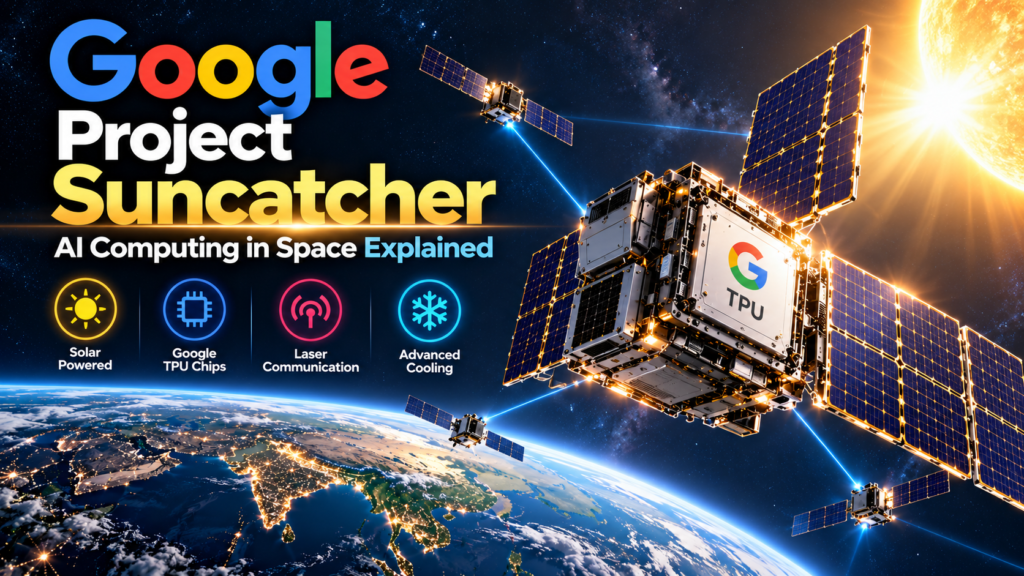
That is the idea behind Project Suncatcher, a Google research project exploring whether satellites powered by the Sun could one day handle large AI workloads in orbit.
This is not a space data center that is ready for customers. It is not replacing Google Cloud, and Google is not about to move Gemini servers off the planet.
For now, Project Suncatcher is an engineering experiment.
But it is moving beyond simulations.
Google says its first TPUs are scheduled to go into orbit as part of an upcoming test mission. The goal is to see how its AI hardware survives the vibration of a rocket launch, radiation in space and the difficult problem of cooling powerful chips in a vacuum.
That makes the project worth paying attention to.
What Is Google Project Suncatcher?
Project Suncatcher is Google’s long-term research effort to explore machine-learning infrastructure in space.
The basic idea sounds almost like science fiction.
Instead of building every future AI computing facility on the ground, Google is studying whether clusters of satellites could carry TPU chips into low Earth orbit and work together as a distributed computing system.
Those satellites could be powered largely by solar energy and communicate with one another using high-speed laser links.
Google first publicly introduced the project in November 2025.
At the time, the company described it as a moonshot rather than a commercial product. The research included satellite design, communication systems and early radiation testing of Google’s custom AI chips.
Nearly a year later, Google is preparing to test some of those ideas in orbit.
Why Would Google Put AI Hardware in Space?
AI needs enormous amounts of computing power.
And powerful computing infrastructure needs a lot of electricity.
That is one reason Google is interested in orbit.
Satellites in low Earth orbit can spend far more time exposed to sunlight than solar infrastructure on the ground. Google estimates that the right orbital setup could generate up to eight times more solar power than comparable systems on Earth.
The attraction is easy to understand.
More sunlight could mean more access to renewable electricity for computing.
But that does not mean space automatically makes AI cheaper or greener.
Getting hardware into orbit is difficult. Cooling it is difficult. Maintaining it is difficult. Connecting hundreds or thousands of computing satellites together would be difficult.
Project Suncatcher exists because Google wants to find out whether those problems can actually be solved.
Google Is About to Put TPU Hardware in Orbit
The latest Project Suncatcher update is important because the project is leaving the lab.
Google says an early mission is being developed with satellite company Planet and is scheduled to fly as part of SpaceX’s upcoming Transporter-18 rideshare mission.
The satellite will carry Google TPU hardware into orbit.
This first test is not about running a giant Gemini model from space.
It is much more fundamental.
Google wants real-world data showing what happens to its hardware during launch and once it reaches orbit.
That may sound basic, but computers designed for a data center on Earth operate in a very different environment from electronics orbiting the planet.
The First Problem: Surviving the Rocket Launch
Before Google’s chips can do anything useful in space, they first have to survive getting there.
A rocket launch is violent.
Google says a spacecraft heading into low Earth orbit can experience sustained acceleration of up to around 10g, while individual components can briefly experience forces much higher than that.
To prepare for this, the Project Suncatcher team put its hardware through vibration testing on multiple axes.
Essentially, they tried to reproduce the shaking and stress the satellite would experience during launch.
The hardware survived those tests.
That does not guarantee everything will work once it flies, but it cleared an important first hurdle.
Radiation Is a Bigger Problem Than It Sounds
Electronics on Earth benefit from the protection of our atmosphere and magnetic field.
Space hardware does not get the same protection.
High-energy particles from the Sun and cosmic radiation can interfere with electronic components and even change stored data.
A single particle can sometimes flip a bit inside computer memory.
For a normal device, that can create an error.
For a system trying to run large AI workloads, repeated errors could become a serious problem.
Google tested its Trillium TPU chips using a proton beam at UC Davis’s Crocker Nuclear Laboratory while the chips were actively running AI workloads.
According to Google, the early results were encouraging. The chips handled a radiation dose greater than what the company expects them to receive during a five-year mission in space.
Lab testing can only tell Google so much, though.
The upcoming orbital mission should show how those chips behave in the real environment.
Cooling AI Chips in Space Is Surprisingly Difficult
At first, putting computers in cold space may sound perfect for cooling.
Unfortunately, it does not work that way.
A data center on Earth can move heat using air, liquid cooling systems and large amounts of surrounding infrastructure.
Space is a vacuum.
There is no air flowing around a hot TPU.
That means the heat generated by the chips still needs somewhere to go.
Google is testing systems that use heat pipes and radiators to move heat away from the TPU hardware and then release it into space.
The team has already tested parts of this cooling setup inside a thermal vacuum chamber.
The real orbital mission will show whether the cooling design behaves the same way outside the lab.
This could turn out to be one of the most important parts of the whole project.
An AI chip that survives radiation but overheats after a few minutes is not particularly useful.
One Satellite Is Not Enough for Serious AI
Modern AI systems rarely depend on a single chip.
Large models run across many processors working together.
The same problem exists in orbit.
Google’s long-term concept involves clusters of satellites, each potentially carrying dozens of TPU chips.
For that to work, those satellites would have to exchange data extremely quickly.
Normal satellite communication is not designed for the same kind of bandwidth that AI computing clusters require.
So Google is working on something different.
Satellites Would Talk to Each Other With Lasers
Project Suncatcher plans to use laser communication links between satellites.
Laser communication itself is not new.
What is difficult here is the type of connection Google needs.
Many existing space laser systems are designed to transmit data across long distances.
Google needs extremely high bandwidth between satellites flying relatively close together. blog.google
Those satellites are also moving at high speed.
That means two spacecraft have to keep their optical systems aligned with extraordinary accuracy while orbiting Earth.
Google compares the precision problem to trying to hit a very small target from miles away while both the transmitter and target are moving. blog.google
The company plans to test this part of the system more directly in 2027, when it expects to place two satellites in orbit for inter-satellite communication experiments. blog.google
Why Solar Power Matters So Much
AI infrastructure is becoming increasingly power hungry.
That is true whether the hardware sits in Virginia, India or low Earth orbit.
Project Suncatcher’s biggest theoretical advantage is that a satellite can spend much more time exposed to direct sunlight.
Google says the right orbital configuration could provide near-continuous access to sunlight and potentially generate up to eight times as much solar energy as an equivalent solar system on Earth. blog.google
That sounds attractive.
But electricity generation is only one piece of the puzzle.
Google would also have to consider:
- launch emissions
- manufacturing
- replacement satellites
- orbital debris
- maintenance
- communications infrastructure
- total system cost
So “solar-powered AI in space” should not automatically be read as “clean AI.”
The environmental and economic picture would depend on the entire system.
Is Google Building a Data Center in Space Right Now?
No.
This distinction matters.
Google is researching whether scalable AI computing in space could eventually work.
The company is not currently operating a full orbital AI data center.
The first mission is about testing hardware.
The next stage will test communication between satellites.
Only after those basic engineering questions are answered would something resembling a large orbital computing system become realistic. blog.google
So headlines claiming that Google has already “moved its AI data centers to space” would be misleading.
The project is still early.
Why Use Google TPUs?
Google has spent years designing its own Tensor Processing Units, better known as TPUs.
These chips are built specifically for machine-learning workloads.
They already power a significant amount of Google’s AI infrastructure on Earth.
Using TPUs in Project Suncatcher gives Google control over both the computing hardware and the software stack around it.
It also lets researchers test hardware they already understand extremely well.
The current experiments use Google’s Trillium TPU generation for radiation and orbital testing. blog.google
Whether future orbital systems would use the same generation is another question.
By the time a large space-based computing system became technically practical, Google’s AI hardware would almost certainly have moved on.
Would Space AI Make Gemini Faster?
Not necessarily.
It is easy to imagine a satellite directly answering your Gemini prompt from orbit, but that is not really what Google is testing right now.
For normal users, latency matters.
A server located close to users can often respond faster than computing hardware located in space and connected through several communication links.
Project Suncatcher is more about whether large amounts of AI compute could eventually be placed in orbit, not whether every chatbot request should be sent to a satellite.
If the idea ever reaches commercial scale, orbital computing could be used for specific workloads where energy availability or infrastructure scale makes sense.
That is still a long way off.
Could It Replace Earth-Based Data Centers?
Probably not in the foreseeable future.
Even if Project Suncatcher works, Earth-based data centers have enormous advantages.
They can be repaired.
Hardware can be replaced relatively easily.
Networks are already connected.
Cooling infrastructure is mature.
Power systems are accessible.
Launching thousands of processors into orbit introduces an entirely different set of challenges.
A more realistic future could involve space computing complementing certain Earth-based infrastructure rather than replacing it.
Google itself is treating the project as long-term research, not as a replacement plan for its existing data centers. blog.google
What Happens If a TPU Fails in Space?
This is another problem that sounds simple until you think about it.
If a TPU fails in a normal data center, engineers can replace hardware.
If it fails in orbit, replacement becomes far more expensive.
Future orbital computing systems would probably need significant redundancy.
That means the network would have to continue operating even if individual chips or entire satellites failed.
Google has not presented a finished commercial architecture for this yet.
And that is precisely why the company is starting with small experiments rather than launching a huge satellite constellation.
What About Space Debris?
Any plan involving large numbers of satellites raises questions about orbital congestion and debris.
Project Suncatcher is currently far from the scale where it would resemble a major satellite constellation.
But if Google ever moved toward hundreds or thousands of computing satellites, safe deployment, collision avoidance and end-of-life disposal would become major engineering and regulatory issues.
Google’s latest Project Suncatcher update focuses mainly on hardware survival, cooling and satellite communication rather than laying out a final large-scale deployment plan. blog.google
That means it is too early to know what a production constellation would look like.
Project Suncatcher Timeline
The project has already moved through a few distinct stages.
November 2025:
Google publicly introduced Project Suncatcher and shared early research around orbital machine-learning infrastructure. blog.google
2026:
Google tested TPU hardware against vibration, radiation and thermal-vacuum conditions. blog.google
Late September / early October 2026:
Google plans to put its first TPU hardware into orbit as part of an early learning mission. blog.google
2027:
The team plans another milestone involving two satellites, allowing it to test the high-bandwidth laser communication needed for future computing clusters. blog.google
Anything beyond that remains research territory.
Why This Project Matters Even If It Fails
There is a good chance some parts of Project Suncatcher will not work as expected.
That would not necessarily make the experiment pointless.
Google’s autonomous-driving and quantum-computing work also spent years dealing with problems that initially looked impractical.
Research projects like this are useful because they expose the real bottlenecks.
Maybe radiation turns out to be manageable but cooling becomes too expensive.
Maybe the chips work perfectly but laser communication becomes the limiting factor.
Or perhaps launch costs fall enough over the next decade that orbital computing starts to make economic sense.
Right now, nobody knows.
That uncertainty is the interesting part.
Is Project Suncatcher About AI Energy Demand?
Energy is clearly part of the story.
AI computing is expanding rapidly, and the electricity needed to train and run large models has become an increasingly important infrastructure question.
Project Suncatcher gives Google a chance to explore a completely different energy model based around almost continuous solar exposure.
Still, the project should not be reduced to “Google is sending data centers into space because Earth is running out of power.”
Google has not said that.
The project is broader research into whether space could eventually become another place where scalable computing infrastructure can operate. blog.google
When Could Space-Based AI Actually Become Real?
There is no announced commercial launch date.
Google has not said that Project Suncatcher will become a product in 2027, 2030 or any other specific year.
The 2027 milestone is another test.
That is an important distinction.
The project still needs to prove:
- TPUs can survive long-term space conditions
- cooling can work reliably
- satellites can communicate at AI-cluster speeds
- launch economics make sense
- systems can operate reliably without physical maintenance
- orbital infrastructure can be managed safely
Until those questions have convincing answers, Project Suncatcher remains research.
What Does This Mean for Normal Users?
Probably nothing immediate.
Your next Gemini request is not suddenly going to space.
Your Google Photos library is not moving to a satellite next month.
For users, Project Suncatcher matters more as a sign of where large-scale computing research is heading.
AI companies are no longer thinking only about faster chips.
They are also thinking about where those chips should run, how they should be powered and what kind of infrastructure could support future demand.
That makes Project Suncatcher interesting even if a commercial system remains years away.
Final Thoughts
Project Suncatcher sounds futuristic because it is.
But underneath the space angle, Google is dealing with very practical engineering problems.
Can an AI chip survive radiation?
Can you cool it without air?
Can dozens of processors on different satellites communicate quickly enough to behave like one computing cluster?
Can the energy advantage of near-constant sunlight justify the difficulty of putting the hardware into orbit?
Those are the questions Google is actually trying to answer.
The first orbital TPU test should provide some of the earliest real-world data.
Then, in 2027, Google plans to take on an even harder challenge by testing high-speed laser communication between two satellites. blog.google
So no, Google has not built an AI data center in space yet.
But it has reached the point where the idea is no longer living only on a whiteboard.
Hardware is about to leave Earth.
And what Google learns from that experiment will tell us whether Project Suncatcher stays an interesting research project—or becomes the beginning of a completely new kind of computing infrastructure.
Frequently Asked Questions
What is Google Project Suncatcher?
Project Suncatcher is a Google research project studying whether solar-powered satellites carrying TPU AI chips could eventually provide scalable machine-learning computing in space. blog.google
Is Google building an AI data center in space?
Not yet. Google is currently testing the basic technologies needed for orbital AI computing. The first mission focuses on how TPU hardware performs during launch and in space. blog.google
When will Google launch its TPU into space?
Google said on September 24, 2026 that its first TPU hardware was expected to go into orbit as part of an upcoming test mission. blog.google
Which chip is Google testing?
Google has been testing its Trillium TPUs, including radiation testing at UC Davis. blog.google
Why does Google want AI computing in space?
One major advantage is solar energy. Google estimates that suitable satellites in low Earth orbit could have access to enough sunlight to generate up to eight times more solar power than comparable systems on Earth. blog.google
How will satellites communicate with each other?
Google plans to use high-bandwidth laser communication links between satellites. A two-satellite test is planned as a 2027 milestone. blog.google
How do you cool AI chips in space?
Because there is no airflow in a vacuum, Google is experimenting with heat pipes and radiators to move heat away from its TPU hardware. blog.google
Will Project Suncatcher replace Google data centers?
Google has not announced any such plan. Project Suncatcher is a long-term research project exploring an additional way of scaling machine-learning infrastructure. blog.google
Disclaimer
This article is based on information published by Google as of September 25, 2026. Project Suncatcher is an experimental research effort, and its design, launch schedule and future goals may change as Google gathers new data from orbital testing.
Official Sources
Google — Behind Project Suncatcher, Our Moonshot to Put AI in Space
Latest update covering the orbital TPU test, radiation testing, cooling research and future laser communication experiments. blog.google
Google — Meet Project Suncatcher
Google’s original 2025 announcement explaining the long-term idea of solar-powered satellite clusters for machine-learning computing. blog.google
Last Updated: September 25, 2026