
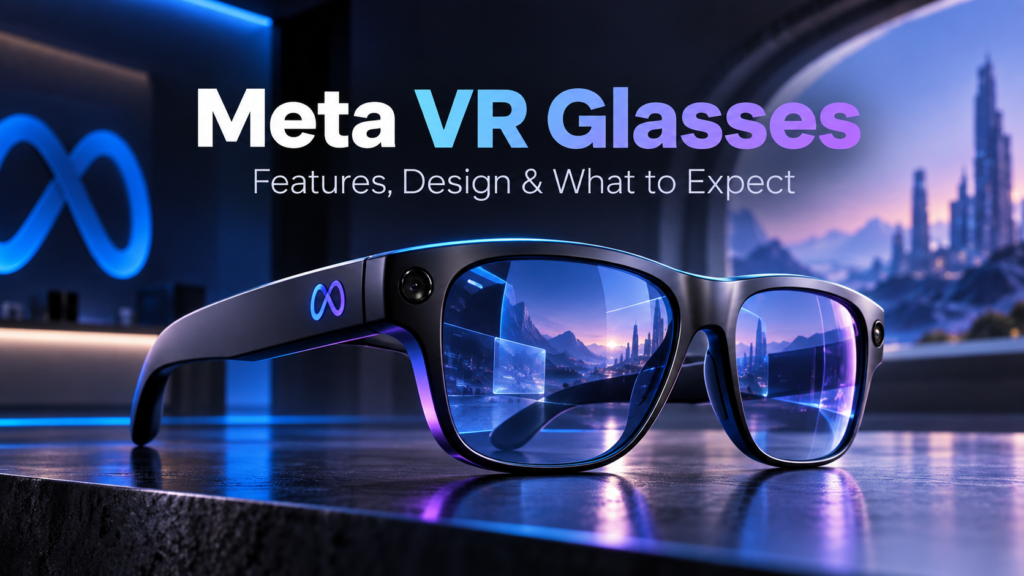
Meta has spent years trying to make virtual reality feel less like wearing a bulky computer on your face.
Its latest answer is the Meta VR Glasses.
Announced at Meta Connect 2026, the new device looks much closer to a pair of glasses than a traditional VR headset. Meta says the glasses weigh about 100 grams, use a 5K micro-OLED display and will go on sale in Spring 2027 for $1,299.99 in the US.
That alone makes them interesting.
But the bigger idea is not simply “a lighter VR headset.”
Meta wants one device to work as a personal cinema, gaming system, private workspace and communication device.
That is an ambitious pitch, so let us look at what is actually confirmed.
What Are Meta VR Glasses?
Meta VR Glasses are Meta’s newest virtual reality device.
Unlike the Quest 3, most of the heavy hardware is not built directly into the headset.
The glasses handle the display and sensors, while a separate small puck carries the processor, battery and storage. That puck connects to the glasses through an optical cable and can be clipped to a pocket, belt or bag.
That split design is one of the main reasons Meta has been able to reduce the weight.
According to the company, Meta VR Glasses are around five times lighter than the Meta Quest 3.
For anyone who has stopped using a VR headset simply because it felt too heavy after 30 or 40 minutes, this may be the most important upgrade.
Meta VR Glasses Price
Meta has confirmed a US price of:
$1,299.99
The device is expected to go on sale in Spring 2027.
That makes it significantly more expensive than a regular Quest headset.
But Meta is clearly not positioning this as an entry-level VR device.
It is closer to a premium spatial-computing product aimed at people who want entertainment, work and gaming in the same device.
Is There a Meta VR Glasses India Price?
Not yet.
Meta has announced the US price, but an official India launch price has not been confirmed.
India Today also notes that India availability remains unclear at the moment.
You may see websites converting $1,299.99 directly into rupees, but that does not give us an official India price.
Local taxes, import costs, retail strategy and regional availability can all change the final number.
So for now:
US price: confirmed
India price: not confirmed
The 100-Gram Design Is the Big Story
Most VR headsets are heavy because the display, processor, cooling system, battery, cameras and other components all sit on your head.
Meta is trying a different approach.
The glasses themselves weigh about 100 grams, which Meta compares to roughly the weight of a deck of cards.
There are no traditional thick head straps.
The sides are more open than a standard headset, and full-colour passthrough cameras allow you to stay aware of your surroundings while using the device.
That could make a major difference for long movies, flights or work sessions.
A device can have an incredible display, but if people do not want to wear it for more than 20 minutes, the technology becomes less useful.
Comfort may matter more here than raw specifications.
5K Infinite Display With Micro-OLED Panels
Meta VR Glasses use what the company calls a 5K Infinite Display.
The system is built on micro-OLED panels and delivers 37 pixels per degree.
That pixel density matters because VR displays sit very close to your eyes.
Text needs to look sharp enough for things like:
- web browsing
- documents
- spreadsheets
- virtual monitors
- movies
- menus
Meta is clearly targeting more than gaming.
The company specifically mentions improved text clarity as one of the benefits of the new display.
Dolby Vision and Dolby Atmos
The glasses also support Dolby Vision for picture quality and Dolby Atmos spatial audio through speakers built into the frames.
That fits with Meta’s focus on movies.
Instead of just creating a huge virtual screen, the company wants the experience to feel closer to having your own private theatre.
First IMAX Enhanced Certified VR Device
One of the more unusual claims is that Meta VR Glasses are the first IMAX Enhanced certified VR device.
Meta says selected movies will be available using IMAX’s expanded aspect ratio.
The company has also announced partnerships with streaming and entertainment companies including Disney+, Prime Video, YouTube, HBO Max, Paramount+, Crunchyroll and others.
This could be especially interesting for people who live in smaller apartments or travel frequently.
Instead of owning a huge television, the glasses can create a large private screen wherever you are.
3D Movies Are a Major Part of the Experience
Meta is leaning heavily into 3D entertainment.
Disney+ is expected to offer selected 3D titles, while Meta is also working with James Cameron and Lightstorm Vision on additional 3D content planned for 2027.
There will also be themed viewing environments.
For example, instead of simply watching a movie on a floating screen, the surrounding virtual environment can match the content.
Whether users actually prefer that over a traditional screen will depend on comfort and content quality.
But it does make the glasses more than just a portable monitor.
Live Sports Could Be One of the Best Uses
Meta is also pushing sports heavily.
The company says Meta VR Glasses will support more than 100 immersive live US sports events per year through partners including ESPN, MLB, NBC Sports, TNT Sports and UFC.
Some events will use 8K streaming and 180-degree camera views.
The idea is to make it feel as if you have a front-row seat even when you are watching from home.
For sports fans, this may end up being more convincing than traditional VR games.
The biggest limitation is that the current announcement is focused heavily on US sports.
Availability in other countries will depend on rights and streaming partnerships.
Meta VR Glasses Can Replace Multiple Monitors
Entertainment is only half of the pitch.
Meta also wants the glasses to become a work device.
You can create one large virtual display or several screens around you.
This means you could potentially have:
- one screen for email
- one for a browser
- one for documents
- one for a video call
without carrying multiple physical monitors.
For travellers, freelancers or people working from small spaces, that could be useful.
Any Flat Surface Can Become a Keyboard and Touchpad
One of the more futuristic features is surface input.
Meta says users can turn a flat table or desk into a virtual keyboard and touchpad.
That means you may not need to carry a physical keyboard for basic tasks.
How comfortable and accurate this is in real use will be important.
Typing a short reply is one thing.
Writing thousands of words on a virtual keyboard is another.
This is one feature that really needs hands-on testing before judging how practical it is.
No Controllers Needed
Meta is moving away from traditional VR controllers.
The glasses support:
- eye tracking
- hand gestures
- voice control
Meta AI is also built directly into the operating system.
You can use these controls to open apps, search for content, adjust your virtual workspace or start a movie.
For casual users, getting rid of controllers could make VR feel much easier.
Picking up two controllers every time you want to watch a video is unnecessary friction.
Using your hands and eyes feels more natural in theory.
Snapdragon Reality Elite Processor
The external puck is powered by Qualcomm’s Snapdragon Reality Elite processor.
Because the processor sits outside the glasses, Meta can keep more heat and weight away from your face.
The puck also contains:
- battery
- computing hardware
- storage
This is a trade-off.
You get much lighter glasses, but you now have a cable connected to a separate device in your pocket.
Some people may prefer that.
Others may find the cable inconvenient.
Battery Life
Meta says the external puck can provide up to three hours of continuous high-resolution media playback.
It also supports 45W fast charging.
Three hours should be enough for most movies or shorter work sessions.
But for an entire workday, users will obviously need to recharge.
That is one area where the lightweight design comes with a compromise.
A much larger built-in battery would add more weight to your face, which Meta is deliberately avoiding.
More Than 75 Games at Launch
Gaming has not disappeared.
Meta says there will be more than 75 games available at launch that can be played using hand gestures alone.
The device will also support Xbox Cloud Gaming, opening access to hundreds of additional games.
That is an interesting strategy.
Rather than trying to make every game run locally, cloud streaming can expand the library without requiring console-level hardware inside the glasses.
A strong internet connection will obviously matter for cloud gaming.
Hologram Calling Sounds Like Science Fiction
Meta is also introducing what it calls hologram calling.
The glasses can create a photorealistic digital representation of you, including facial expressions and reactions.
During a call, another person wearing the glasses can see that representation positioned in front of them.
Meta says it can also work with existing calling services such as WhatsApp and Zoom.
If the other person joins through a normal phone or computer, they can still see your digital representation on their screen.
This is one of those features that will either feel surprisingly natural or slightly strange.
Real-world use will tell us more than a demo.
Meta VR Glasses vs Quest 3
The biggest difference is obvious:
Quest 3 is a traditional headset.
Meta VR Glasses are designed to feel closer to actual glasses.
The new glasses are dramatically lighter because the battery and processor move into the external puck.
They also focus more heavily on:
- long-form entertainment
- virtual monitors
- media consumption
- natural hand control
- spatial communication
The Quest line is still much more established for mainstream VR gaming.
Meta VR Glasses appear to be aimed at a more premium audience.
Are These Smart Glasses or VR Glasses?
This distinction is important.
Meta already sells smart glasses such as Ray-Ban Meta devices.
Those products are designed for everyday use and look much closer to normal sunglasses.
Meta VR Glasses are different.
They provide immersive VR displays and virtual environments.
Think of them more as a dramatically lighter VR headset than a replacement for regular eyewear.
The name “glasses” describes the form factor.
The experience is still much closer to virtual reality.
Can You Wear Meta VR Glasses for Work?
That is clearly one of Meta’s intended use cases.
The combination of:
- sharp text
- multiple virtual monitors
- passthrough
- virtual keyboard
- hand gestures
- lightweight design
makes them more work-focused than a typical gaming headset.
Still, several questions remain.
Is the text comfortable to read for six hours?
Is the virtual keyboard accurate enough?
Does the cable become annoying?
Is three hours of battery enough?
These are things specifications cannot answer.
What About Privacy?
A device with cameras, eye tracking, hand tracking and an AI assistant naturally raises privacy questions.
Meta has explained the hardware and capabilities, but users should pay attention to detailed privacy controls once the device ships.
In particular, it will be important to understand:
- what data stays on the device
- what is processed in the cloud
- how eye-tracking information is handled
- what Meta AI stores
- how camera access is controlled
Those details will matter more once the final consumer software and privacy documentation are available.
Meta VR Glasses Specifications at a Glance
Here are the main confirmed specifications so far:
- Approx. 100g glasses weight
- 5K Infinite Display
- Micro-OLED panels
- 37 pixels per degree
- Dolby Vision
- Dolby Atmos spatial audio
- Full-colour passthrough
- Snapdragon Reality Elite processor
- External compute/battery puck
- Up to 3 hours media playback
- 45W charging
- Eye tracking
- Hand gesture control
- Meta AI integration
- IMAX Enhanced certification
- 75+ games at launch
- Xbox Cloud Gaming
- Multi-screen workspace
- Virtual keyboard and touchpad
- Hologram calling
- Spring 2027 launch
- $1,299.99 US price
Should You Buy Meta VR Glasses?
It is too early to give a final buying recommendation.
The device does several things that sound genuinely impressive.
The 100-gram design solves one of VR’s biggest problems.
The 5K display should make virtual monitors more realistic.
The movie and sports partnerships could make entertainment much more compelling.
But $1,299.99 is still a serious amount of money.
And we do not yet know how comfortable the device feels after several hours of real-world use.
For now, it looks most interesting for:
- VR enthusiasts
- frequent travellers
- remote workers
- premium entertainment buyers
- developers
- early adopters
Mainstream users may prefer to wait for hands-on reviews and broader availability.
What About India?
Indian buyers should wait for an official regional announcement.
Meta has not confirmed an India price or clear India launch date yet.
Importing the US version immediately may also create questions around warranty, regional services, streaming rights and support.
If Meta confirms an India launch later, that will be the right time to compare local pricing.
Final Thoughts
Meta VR Glasses may be one of the more interesting VR launches in years, not because they have the biggest specification numbers, but because Meta is trying to solve the part of VR people complain about most: wearing the device itself.
At around 100 grams, this is much closer to something you might actually wear through a movie or long flight.
The rest of the package is ambitious too.
5K micro-OLED displays, IMAX movies, immersive sports, Xbox Cloud Gaming, virtual monitors and hologram calls all point toward a product that wants to replace several different screens.
Whether that works in everyday life is still the big question.
Meta VR Glasses arrive in Spring 2027 at $1,299.99 in the US. Until then, the most important thing will be seeing how the hardware performs outside a launch presentation.
Frequently Asked Questions
How much do Meta VR Glasses cost?
Meta has announced a US price of $1,299.99.
When will Meta VR Glasses be released?
Meta says the glasses will go on sale in Spring 2027.
How much do Meta VR Glasses weigh?
The glasses weigh approximately 100 grams.
What display do Meta VR Glasses use?
They use a 5K Infinite Display based on micro-OLED panels, with 37 pixels per degree.
Do Meta VR Glasses need controllers?
No traditional controllers are required for many interactions. Meta supports eye tracking, hand gestures and voice controls.
Can you play games on Meta VR Glasses?
Yes. Meta says more than 75 hand-controlled games will be available at launch, with additional games through Xbox Cloud Gaming.
Can Meta VR Glasses be used for work?
Yes. Meta supports multiple virtual screens and can turn a flat surface into a virtual keyboard and touchpad.
Will Meta VR Glasses launch in India?
Meta has not yet confirmed an official India launch date or price.
Disclaimer
This article is based on information officially announced by Meta and reporting available as of September 24, 2026. Features, availability, regional pricing and software capabilities may change before the product ships in Spring 2027. Always check Meta’s official product pages for final launch details.
Official Sources
Meta Newsroom — Introducing Meta VR Glasses
Official details covering the 100g design, 5K display, entertainment features, gaming, workspace tools, battery and pricing. Facebook
Meta Blog — Meta VR Glasses Announcement
Official launch information and Spring 2027 availability. Meta
India Today — Meta Connect 2026 Coverage
Additional India-focused reporting on specifications and current India availability. India Today
Last Updated: September 24, 2026